


How to Set Up an India ODC: A 90 Day Hiring Plan for Your First 15 Engineers
More US companies are choosing India for their next engineering team. ANSR Research data, reported by Moneycontrol, shows US-headquartered companies set up over 60 new global capability centres in India in 2025, about 45% more than in 2023 and up from roughly 43 in 2024. ANSR projects 75 to 80 more in 2026.
A Business Standard report from 7 November adds the next step. Industry experts expect existing India centres to expand first, with new set-ups following through 2027. They also see mid-sized US and European companies in healthcare, insurance, retail, manufacturing and energy considering centres of their own.
For a mid-size company, the decision is the easy part. The hard part is hiring the first 15 engineers fast enough that the ODC becomes a real team, not a slide in a board deck. This guide gives you a 90 day plan.
This article is general information, not legal or tax advice. Get local advice on your set-up.
First, define what "hired in 90 days" means
There are two different finish lines, and teams often mix them up:
- Offer accepted: the engineer has said yes.
- Joined: the engineer has served their notice and started work.
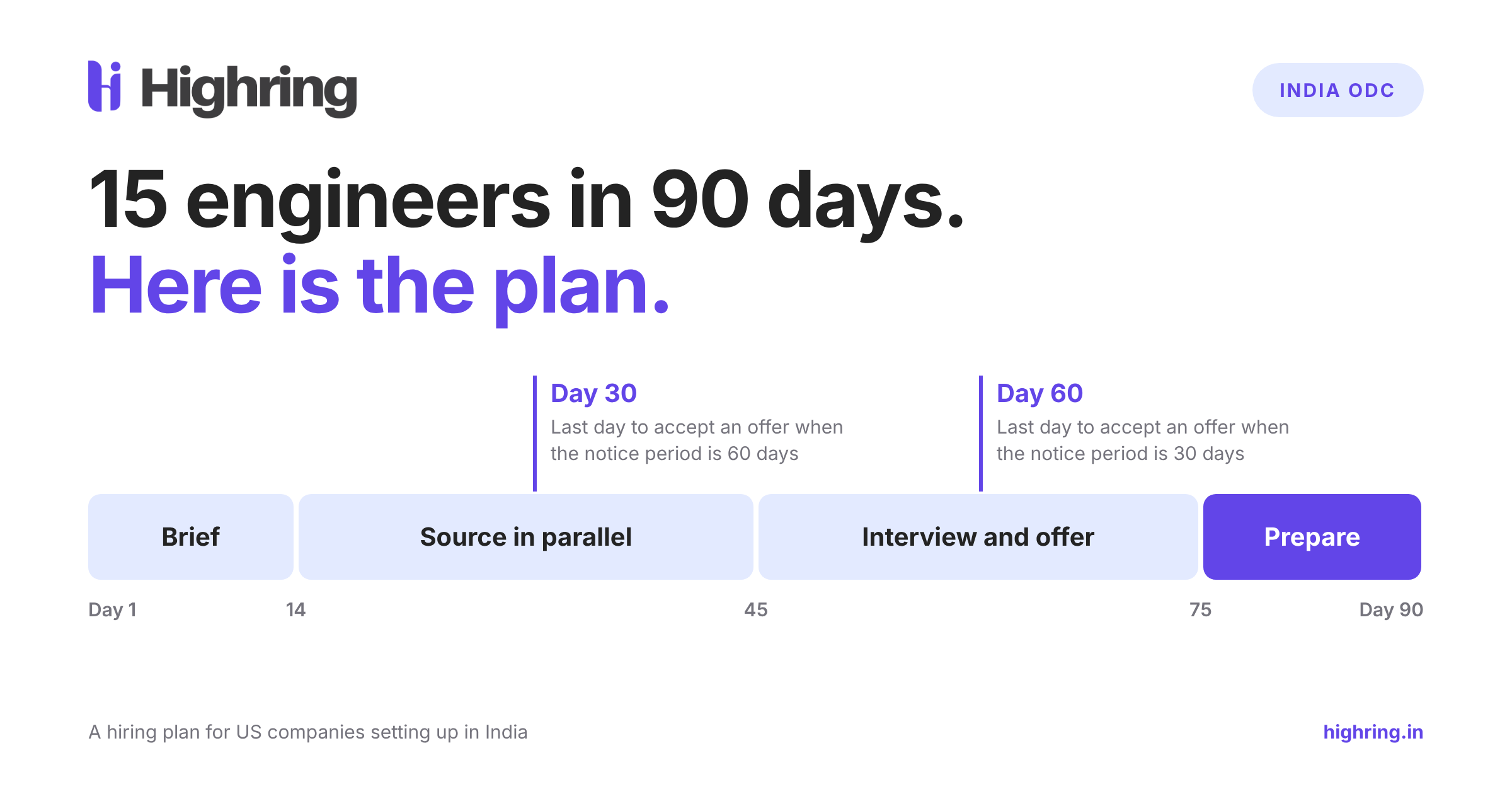
Experienced engineers in India commonly serve notice periods of 60 to 90 days. So "15 engineers in 90 days" can only mean 15 joined if most offers are accepted early. This table shows the last day to accept an offer for someone to join by day 90:
| Notice period | Last day to accept an offer |
|---|---|
| 30 days | Day 60 |
| 60 days | Day 30 |
| 90 days | Not possible, unless the employer agrees to a buyout |
The plan below works backwards from these dates.
Days 1 to 14: Decide the shape and write the brief
Pick the team shape. As an example, 15 engineers could be one engineering lead, two senior engineers, ten mid-level engineers, one QA engineer and one DevOps engineer. Hire the lead first. The lead then helps interview everyone else.
Choose how the team will be employed. You can use your own Indian entity, an employer of record, or a delivery partner. This decides who issues offers and runs payroll, so settle it before you make a single offer.
Write a real brief for each role. Name the three to five skills that decide success in the first 90 days. Set the budget in INR, as a CTC range. Decide which cities work, because Hyderabad, Pune, Bengaluru and Delhi-NCR compete for the same people.
Days 15 to 45: Source in parallel, not in sequence
TeamLease's September report found that 72% of hiring employers face moderate to significant difficulty filling roles. Waiting on one agency at a time will not work.
- Brief several specialist agencies on the same day. Give them the same brief and the same deadline.
- Ask for a screening summary with every profile: verified skills with examples, notice period, current and expected CTC, and the reason for leaving.
- Prefer short notice periods for the first wave, so people can join inside your 90 days.
- Name one decision maker who answers every profile within 48 hours.
Days 45 to 75: Interview fast and make offers early
- Run interviews within a few days of each shortlist.
- Decide soon after the last round. Strong engineers often hold several offers.
- Put the joining date in writing in the offer.
- Keep a backup candidate warm for every key role, because joining risk is real.
Days 75 to 90 and beyond: Prepare for the first joiners
Order laptops, accounts and access before day one. Set up payroll and documents. Plan a proper first week, because a bad start loses people you worked hard to hire.
Remember that candidate data is personal data. India's DPDP rules take full effect in May 2027, so agree now how your team and your agencies will handle resumes and contact details.
Five mistakes to avoid
- Briefing one agency at a time. It adds weeks.
- Not defining "hired". Offers accepted is not the same as people joined.
- Slow feedback. Agencies cannot improve without it, and candidates take other offers.
- No backup candidates. One late withdrawal can sink a joining date.
- Setting the employment route late. Offers cannot go out until it is settled.
Where a marketplace fits
A recruitment agency marketplace lets you post each role once and reach several specialist agencies at the same time, in one system. Duplicate submissions are flagged, and the first agency to submit a candidate is recorded, so you do not waste time on ownership disputes. You pay only when a hire joins, with no upfront fee.
The bottom line
Building an ODC is a hiring project with a deadline. Define what "hired" means, work backwards from notice periods, and brief several agencies at once. Teams that do this reach their first 15 engineers faster, with fewer surprises.
See how a recruitment agency marketplace works for your ODC hiring. Book a free 20-minute demo.
Highring is a recruitment agency marketplace for companies and agencies. We are not a job board and do not accept direct resumes from candidates. This article is for general information only and is not legal or tax advice.