


How IT Companies in India Can Manage Multiple Recruitment Vendors Without the Chaos
If you are an HR manager at an IT company in India, you already know what Monday morning looks like.
Your phone has three unread WhatsApp messages from vendors asking for the job description you sent last week. Your inbox has forty-two CVs from six different agencies. At least twelve of those CVs are the same candidate submitted by different vendors. Your hiring manager just walked over asking for an update on the React developer position that has been open for three weeks. And you have not had your morning coffee yet.
This is not a bad day. This is a normal day.
And the frustrating part? None of this is really anyone's fault. Your vendors are doing their job. Your hiring manager needs the position filled. Your HR team is trying their best. The problem is not the people. The problem is that there is no system holding everything together.
Why This Problem Exists in the First Place
India's IT sector depends heavily on recruitment vendors. Most mid-size and large IT companies work with anywhere between five and fifteen agencies at any given time. This is not a choice it is a necessity. No single vendor has access to every candidate in the market. So companies spread their requirements across multiple agencies to cast a wider net.
In theory this works well. In practice it creates a coordination nightmare.
Think about what actually happens when you open a new position. You send the job requirement to your vendor list usually over WhatsApp or email. Each vendor starts asking clarifying questions. You answer the same question seven times over. A few days later CVs start coming in. Some vendors send five profiles. Some send twenty. Nobody has a standard format. Nobody respects the experience criteria. And three vendors send you the same candidate because that candidate is also actively applying everywhere.
Now you have to sort through everything manually. You open each CV in a separate tab. You try to remember who sent what. You maintain a spreadsheet to track which candidates are shortlisted, which are rejected, which are in discussion. That spreadsheet gets outdated within twenty-four hours because nobody is updating it in real time.
This is before a single interview has even been scheduled.
The Numbers That Should Concern Every HR Leader
Here is something most people do not talk about openly but every HR professional privately knows.
The average HR manager in India spends two to three hours every single day just managing the vendor coordination process. Not interviewing candidates. Not building hiring strategy. Not working on employer branding. Just managing the chaos. Follow-up messages. Duplicate CV checks. Status updates. Vendor calls.
Multiply that across a five person HR team and you have ten to fifteen hours of pure administrative work happening every day. That is almost two full working days of productivity lost every single week.
For a company that is trying to scale from two hundred employees to five hundred that is a serious problem.
What Most Companies Try to Do and Why It Does Not Work
Over the years companies have tried various workarounds.
Some create shared Excel sheets and ask all vendors to log their submissions there. This works for about two weeks before the sheet becomes a disaster of conflicting entries, wrong formats and outdated information.
Some try ATS tools applicant tracking systems built for direct hiring. These work reasonably well for managing candidates but they are not built for the vendor relationship. They have no concept of vendor accountability, no way to track which vendor submitted which candidate first, no invoicing module tied to placements.
Some companies just accept the chaos and hire more HR executives to manage it. Which solves nothing it just distributes the chaos across more people.
The fundamental issue is that none of these solutions were built specifically for the way Indian IT companies actually work with their recruitment vendors.
What Actually Needs to Happen
Let us think about what the ideal process looks like without any tool constraints.
A company opens a position. All relevant vendors are informed automatically with the complete job details. Vendors submit candidates through one channel. The company sees all submissions in one place. Duplicate submissions are flagged immediately so there is no confusion about who submitted first. The company shortlists candidates and shares feedback with vendors without picking up the phone. Interviews get scheduled and both the vendor and the candidate are informed. Once a candidate is hired the company confirms the placement and the billing process begins automatically based on pre-agreed terms.
Everything is visible. Everything is trackable. Nobody has to chase anyone.
That is not a fantasy. That is just good process design. And it is absolutely achievable if you have the right system.
Five Practical Steps to Reduce Vendor Chaos Right Now
Whether you are looking at a software solution or not here are five things you can do immediately to get better control over your vendor relationships.
1. Standardise how you share job requirements
Stop sending requirements over WhatsApp. Create a standard JD template and share it over email every single time. Include must-have skills, nice-to-have skills, experience range, budget range and the expected timeline. The more specific you are upfront the fewer clarification calls you receive.
2. Set a submission deadline for every position
Tell your vendors that CVs for a particular position will be accepted only until a specific date. This creates urgency, reduces the trickle of late submissions and helps you batch-process candidates instead of constantly reviewing new ones.
3. Create a simple first-come-first-served rule for duplicate CVs
Vendor conflicts over candidate ownership are one of the biggest sources of tension in vendor relationships. Solve this once and for all with a clear written policy the vendor who submitted the candidate first gets credit. Communicate this to all vendors in writing. Stick to it without exceptions.
4. Give feedback within forty-eight hours
Vendors stop putting in their best effort when they receive no feedback on submitted profiles. A simple shortlisted, rejected or on hold status shared within forty-eight hours costs you nothing and dramatically improves vendor engagement and quality over time.
5. Consolidate your vendor communication to one channel
Pick one channel for all vendor communication email, a shared portal, whatever works and stick to it. The moment vendor management splits across WhatsApp, email, phone calls and spreadsheets simultaneously you lose control of the process.
When You Need More Than Just Better Habits
The five steps above will help. But they have limits.
They require discipline to maintain. They do not scale when you have ten open positions running simultaneously. They do not solve the duplicate CV problem at scale. They do not give you real-time visibility into your pipeline. They do not automate the invoicing and payment process.
At some point especially for companies that are hiring at volume you need a system that does this for you.
This is exactly what we built Highring for.
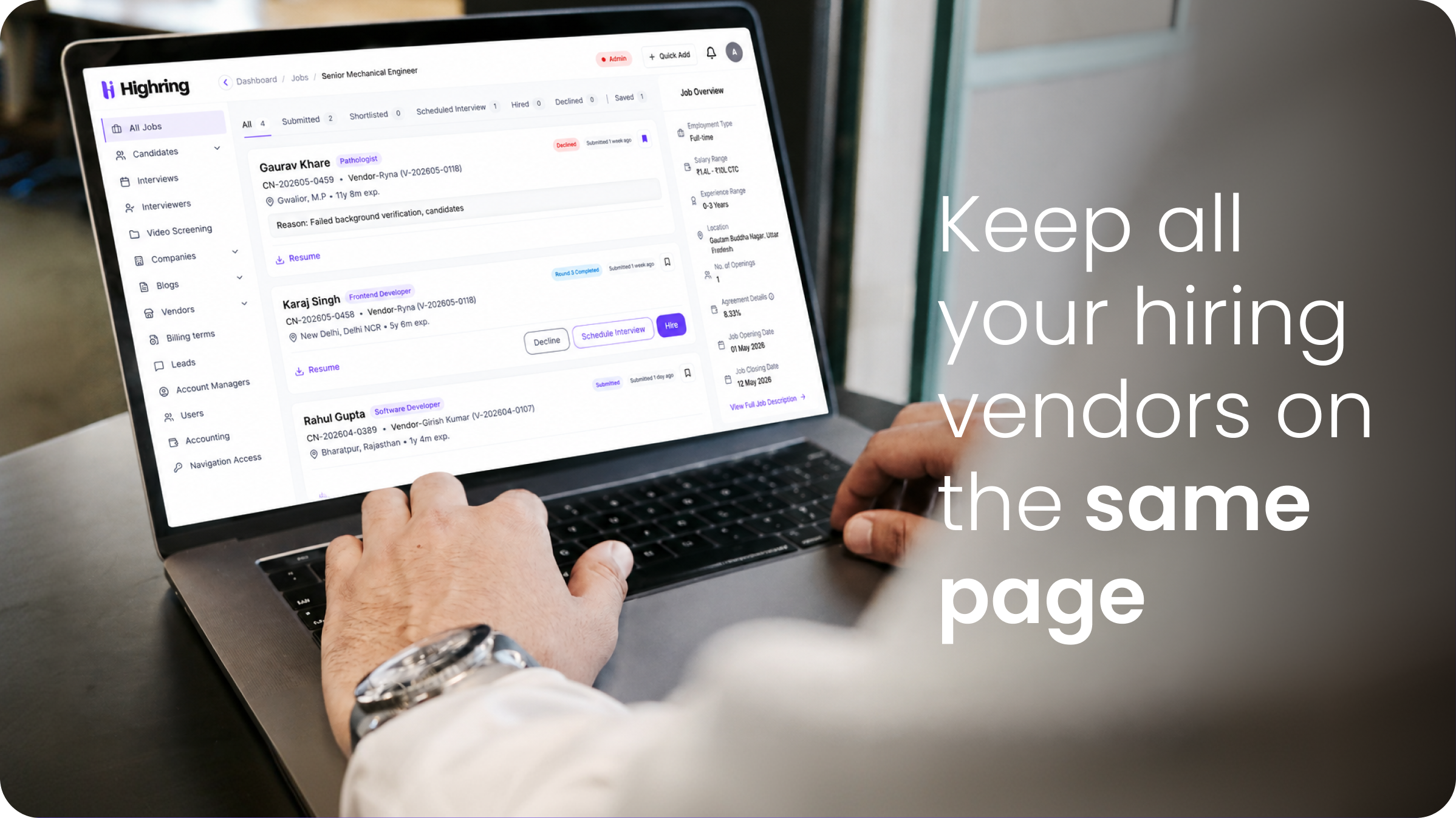
Highring is a recruitment platform built specifically for the relationship between IT companies and their vendors. Companies post jobs once and vendors get notified automatically. All CV submissions come into one dashboard. AI flags duplicates instantly. Interviews can be scheduled with a calendar link without a single follow-up call. Every placement is tracked from submission to joining. Invoices are calculated automatically based on pre-agreed terms.
Everything your HR team currently does manually Highring handles in the background.
The Bigger Picture
Here is something worth stepping back to think about.
The quality of your hiring directly affects the quality of your team. The quality of your team directly affects the quality of your product and your ability to grow. And the quality of your hiring is heavily influenced by how well your recruitment process is managed.
When your HR team is buried in vendor coordination, duplicate CVs and follow-up calls they have less time and mental energy for the things that actually matter. Like evaluating cultural fit. Like building relationships with candidates. Like creating a great interview experience that makes top talent want to join your company.
Fixing your vendor management process is not just an HR efficiency problem. It is a company growth problem.
The good news is it is completely fixable.
Ready to See How It Works?
If your HR team is currently managing recruitment vendors on WhatsApp, email and Excel we would love to show you what a better process looks like.
Visit highring.in to learn more or book a free demo with our team.
No commitment. No lengthy onboarding. Just a twenty-minute walkthrough to see if Highring makes sense for your team.
Highring is a recruitment platform that connects IT companies with their vendors in one place. Post jobs, manage CVs, schedule interviews and track placements all in one dashboard.